Sunday, January 04, 2009

A new beginning


A brand new year! Lots to look forward to, lots to discover and enjoy. I wonder what 2009 will bring for our family?!?... I hope to learn and grow, to love and live to the fulllest!

I have to start to unpack ... and get everything in order again! So far, this year have been a very exciting one! We survived 23 hours of travelling, hauling +106 kgs of luggage plus 16kgs of Fabi. Just like the movie, we rode "a plane, a train and an automobile" to get home in Erlangen. We're missing all our friends and family that we left behind in Mumbai, but we feel wonderful that we got a chance to get closer to them during our recent visit to India.

HAPPY 2009 everyone!

Labels: , , ,

Friday, December 26, 2008

FELICES FIESTAS! - HAPPY 2009!

We have spent a very special Christmas Day (Mass in Goa, India) and we'll be spending our New Year's in Mumbai. We are thinking of all of our friends and family members who are physically far away from us, but so close to our hearts!

Best wishes from Mariluz, Ishan and Gaurang Fabian!

Labels: , , , ,

Tuesday, November 11, 2008

India en fotos

Fabian is visiting his birthtown after 2 years and 4 months. Lots of things have changed in Vashi, Navi Mumbai. I feel right at home! It's nice...and weird at the same time! Follow us in pictures.
Ya saque la cuenta: hace 2 anyos y 4 meses que Fabian y yo nos fuimos de India. Intentare actualizar esta pagina con anecdotas e impresiones de este viaje de visita. Me pueden seguir la pista en este album de fotos en FLICKR.

Labels: , ,

Monday, October 27, 2008

HAPPY DIWALI!

Diwali Meaning & Significance

Deepavali is a festival where people from all age groups participate. They give expression to their happiness by lighting earthen 'diyas' (lamps), decorating the houses, bursting firecrackers and inviting near and dear ones to their households for partaking in a sumptuous feast. The lighting of lamps is a way of paying obeisance to god for attainment of health, wealth, knowledge, peace, valor and fame.

It is one time in the whole year that children volunteer to leave their beds long before the day begins. In fact, the traditional oil bath at 3 a.m, is the only chore that stands between them and the pre-dawn adventures. They emerge, scrubbed clean to get into their festive attire, and light up little oil lamps, candles and scented sticks(agarbathis), the wherewithal for setting alight crackers and sparklers.

On Diwali night, little clay lamps are lit in Hindus homes, but now a days colored electric lamps are also used. What is the significance of lighting a lamp? There is a logical answer to this question. It is through the light that the beauty of this world is revealed or experienced. Most civilizations of the world recognize the importance of light as a gift of God. It has always been a symbol of whatever is positive in our world of experience. To Hindus, darkness represents ignorance, and light is a metaphor for knowledge.

Therefore, lighting a lamp symbolizes the destruction, through knowledge, of all negative forces- wickedness, violence, lust, anger, envy, greed, bigotry, fear, injustice, oppression and suffering, etc. Competition is stiff, and even the little girl in silk frocks and their finery are watching out for the best sparklers and flowerpots, the rockets and Vishnuchakras, which light-up the night sky like a thousand stars. Grown-ups are the soul of generosity. Festive bonhomie abounds.

(Source)

Labels: ,

Thursday, August 28, 2008

Matussek goes Bollywood.

A video blog from Spiegel Online. (In German)

Labels: , ,

Saturday, August 16, 2008

Raksha Bandhan

The Hindu festival of Raksha Bandhan celebrates the relationship between brother and sisters.

Faithful to the tradition, a very special package arrived just in time for this day: rakhi for Ishan and Gaurang from his cousin-sisters in India!


Thank you Sheetu, Shriya, Chiu, Suhaani & Krishna!

Labels: , ,

Sunday, October 28, 2007

A bank in Delhi


I think this is cool!...

Via Boing Boing

Labels:

Monday, August 20, 2007

India´s Independence (revisited)

Costa Rica´s newspaper La Nacion, published the Spanish version of this interesting article, "India´s Democracy at 60":
  • "...the India that emerged from the wreckage of the British Raj is the world’s largest democracy, poised after years of rapid economic growth to take its place as one of the giants of the twenty-first century."

El periódico de Costa Rica, La Nación, publicó este interesante artículo con motivo del 60 aniversario de la independencia de India:

  • "...la India que surgió de entre las ruinas del Raj británico es la mayor democracia del mundo, lista, después de años de rápido crecimiento económico, para ocupar su lugar como uno de los gigantes del siglo XXI."

Labels: ,

Wednesday, June 27, 2007

India Flashback

I just came across Firangi Mama - a blog by a New Englander with a South Indian husband and their little girl. They lived in Bangalore for some time and now they´re back in the U.S.A. I enjoyed reading her archives and found the following anecdotes very familiar because they brought memories of my days in India:

-
The value of money.

- The funny (and frustrating) experience trying to communicate with the maids.

- Cooking with Light Propane Gas.

- Funny Indian English terms: "leg-finger" means toe; "my head is paining" means "I have a headache"; the expression: "What is your good name?" (as if you also had a bad one!)

- Funny Indian English pronounciation: The letter A is the letter /yay/. The letter W pronounced as/v/, i.e woman /voman/.

-How foreigners are pointed out and stared at. I also heard this question quite often:
"You are basically from which place, madam?"

-
Beggars

- Grown-ups being referred to as "Auntie" and "Uncle" out of respect.

- Having an "office boy" or driver come to your rescue. (Hi, Hemant! Hi, Arjun!)

- The black dot on a baby´s head to avert the Evil Eye.
Shaving a baby´s head (even if it´s a girl) to make the hair thicker or for religious purposes.

-
You should never go back (towards the house, once you leave in the morning. Brings bad luck!)

- The way
religions co-live in one environment.

-
Indian etiquette. (I enjoyed this post. Very true!) My MIL once asked me three times if I wanted more food at a family dinner in a restaurant. She just wanted to make sure I wasn´t eating because I was feeling shy.

-
You´re not suppossed to smell the pooja flowers.

- English sounds like a
different language when spoken with another accent. (My anecdote is that the anesthesiologist was telling me something right before my emergency C-Section operation and I said: "I only speak English". And he replied: "But I am speaking English only!". -- I´m sure Sopan & Priya also noticed that I eventually asked them to repeat things less often. One day SIL-Priya kept asking me if I wanted an "egg-fry" and it was only when I saw her put an egg on the frying pan that I understood she was asking me if I wanted a "fried egg"!)

-Buying eggs that come in a normal plastic cover and some even have chicken poop on them. I still don´t know why a friend of mine in Vashi was surprised to see me wash the eggs before putting them on the refrigerator.

-
Child-rearing advice from your Mother-in-Law. (In my case, my MIL suggested I keep a young boy to help me around the house when Fabi was a newborn. I declined, as I just wanted ONE kid in the house and not feel responsible for having a child-laborer).

-
Missing the dhobi.

-
The correct way to refer to people.

- Learning that my marriage is a "love marriage". I was shocked the first time I heard this expression...Is there any other kind? Oh!...yes...as oppossed to an "
arranged marriage"! (Btw, good Blogher post on the topic of arranged marriages here.)

- Basically, knowing that
India changes you.

(You can read all my posts of my "Life in India" here.)


Labels:

Monday, July 24, 2006

It was *ABOUT* time!!!!!! --UPDATED--

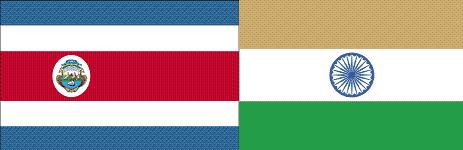
I never wrote the gory details of what it's like to go through the process of requesting an entry visa for an Indian citizen who wants to visit Costa Rica.


Let me tell you the (very) short version:

  • Indian passport holders need a so-called 'restricted visa' to go to Costa Rica.
  • This means having to write an application letter, filling out a form, submitting proof of economic viability and giving all these papers to the Honorary Costa Rican Consul in Delhi.
  • Then you patiently wait for the Consulate's office to send the application to the Immigration offices in Costa Rica (after they are done with their 'internal proceedings', whatever that means).
  • Then you will most likely receive a rejection from the Immigration offices in Costa Rica.
  • So the next step is to have someone in Costa Rica submit another application.
  • Second time around, if the application is accepted, with luck, the applicant would not have to pay a significant amount of money as a deposit (which would be returned after the visitor went back to India).
  • The concerned authorities between Costa Rica and India communicate through fax. They take a LONG time to reply to each other's messages (which have to be translated).
  • The visas that are granted by the Immigration offices in Costa Rica always come back with restrictions, such as: 'Must get passport stamped withing 30 days after the visa was granted', 'May only visit Costa Rica for one month'.

Remember...this is the SHORT version. I will spare you with the agonizing details, but I will tell you that I went through this hell twice: for MasalaDad when he came to Costa Rica in 2003 (for our wedding) and for Fabi who also has an Indian passport.

After Fabi's visa got rejected...it took 6 months (!) for the application to go through. Since the visa was valid for only one month, it already got expired and I had to go to the Immigration offices again and get it renewed.

Dealing with all these bureaucratic procedures wears me out and I have come to hate them in a way I have never hated anything in my life!

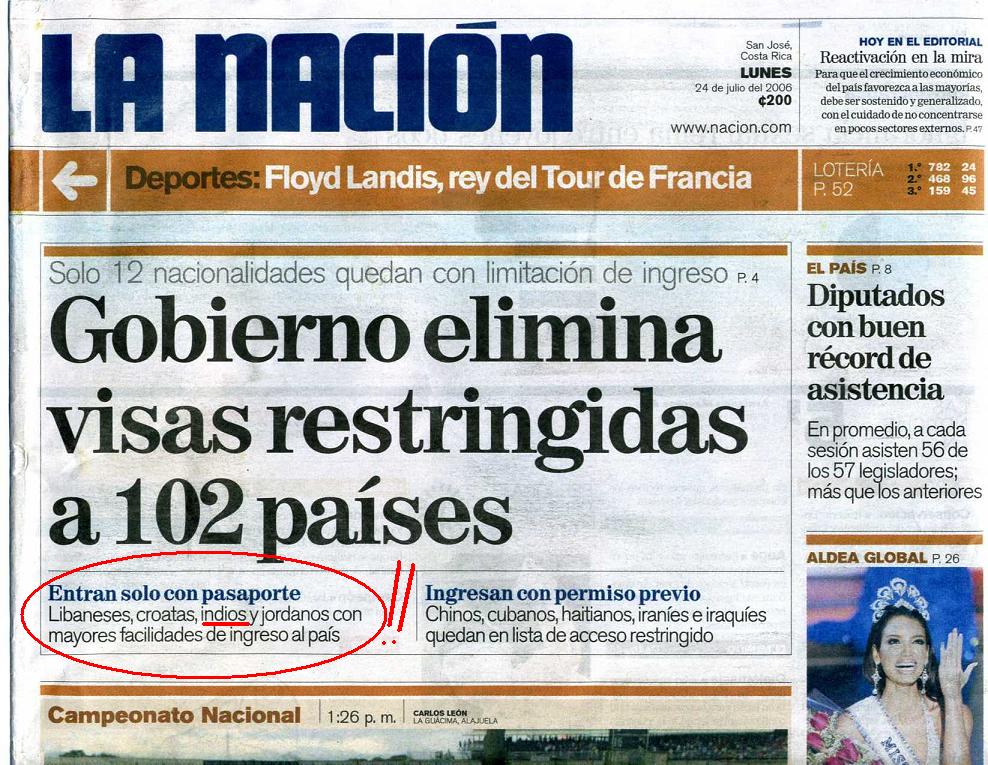
That's why you might understand the reason of my excitement this morning when I read today's newspaper:


The front page of the newspaper announces that, as of July 14th, 2006, indian citizens DO NOT REQUIRE a visa to come to Costa Rica (and may stay for up to 30 days)! Let me repeat that: Indian citizens DO NOT REQUIRE a visa to come to Costa Rica!

The last time I felt THIS excited was when I learned that I had been accepted as a student at the Technische Fakultät. It's the same type of excitement that makes me wildly jump up and down with joy!

So....now you know....if you're an indian citizen you now fit in the category of "Have passport, will travel"....as long as your destination is Nepal or Costa Rica...you don't need any other formal document.

When are you coming to Costa Rica?!?!

UPDATE: (Aug. 2008)

I visited Costa Rica one year later and learned that SADLY, it was all temporary. Apparently Indians need a visa to go visit Costa Rica again. I don't know if a 'restricted visa' still applies. If so...well...I will have to be prepared for the next time MasalaDad wants to visit CR. It's a good thing that Fabi now owns a Costa Rican passport.

Labels: ,

Thursday, March 30, 2006

Happy New Year....in March!

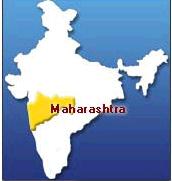
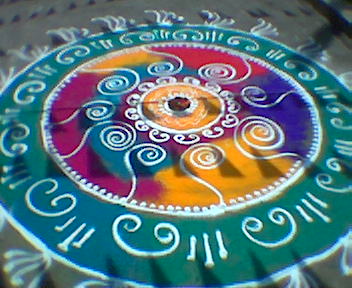
The picture on the left is a map of India with the outline of the state of Maharashtra - where we live. The Maharashtrians are celebrating their New Year today: 'Gudi Padwa'. This is a celebration of springtime and harvest. At this time of year the weather is hot, mangoes are in season, it's time to clean the house and get new clothes!


As part of the celebrations, people decorate with rangoli (see colorful picture above) and hang 'gudis' out of the windows (see picture below). A 'gudi' is a pole on top of which an upturned brass or silver pot called a kalash is placed. The gudi is covered with a colourful silk cloth and decorated with coconuts, marigolds and mango leaves that symbolize nature’s bounty.


I like the idea of New Year in March...it's a 2nd chance for my New Year's resolutions!... ;)

Labels:

Wednesday, March 29, 2006

It happens *ONLY* in India!....

When was the last time this happened to you...?

"You're walking down the street, minding your own business, doing some window shopping, and all of the sudden you see something really big walking on the SAME SIDEWALK coming towards you....something like... an elephant.

Oh, wait! It *IS* an elephant!..."


Yes! That's right! Fabi and I ran into an elephant ...and it happened right here in the SIDEWALKS of Vashi!... I don't know what was more amazing: the elephant or the normalcy of people walking by. I just had to stop so that Fabi could take a good look....eventhough it was a baby elephant....it was HUGE! I've seen elephants on the street before...but never on the same sidewalk I was using!

This is why I should ALWAYS have a camera with me!

Labels:

Sunday, March 19, 2006

'India Week' - Way of Life - Part II

This is the final entry for the theme 'India Week'. I hope you enjoy these last pictures as much as I enjoy telling you about what I've learned here.
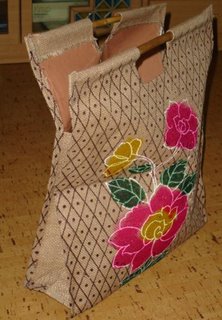
It is well known that this country has a very rich culture, one that is very hard to grasp all at once. I keep learning things almost on a daily basis and no matter how much I read, the most interesting part for me is to discover something new when interacting with people. For example, I had posted about the festivity called 'Makar Sankrati'. I thought I knew all there was to know about this day, until Roopa Maushi (Ishan's maternal aunt) surprised me with the new bag you see in the picture below. It turns out that another tradition on this day is for women to exchange bags - so that when this season (of spring) begins, they have a new bag to go shopping.
The next couple of pictures are about customs that people follow in Hinduism. No matter how much I tell you about what I've seen here, I won't be anywhere near to scratching the surface of all there is to tell. My first experience with such customs was with aarti, when Ishan and I visited his relatives' homes for the first time as a newlyweds. The married women performed aarti to me also on my 'Indian Baby Shower' (Godh Bharna) and I performed it to Ishan's father on his birthday.

When Fabi was just a few months old, one of the neighbors insisted we go visit her. I finally got around to go to her house on a Friday and I came back with a red bindi (dot) on my forehead and wearing flowers on my head. (Unfortunately, I lost that picture when my hard disk crashed.) It turned out that I had visited her on an auspicious day and therefore I got that special treatment. It was just one of those days when a married woman visits your house is a good sign.

There are so many customs. For example, there's a special ceremony when a baby gets his first bite of solid food; and there's also the time to remember the ancestors and people actually refrain themselves of things such as buying a new house during such time. It's always about waiting or celebrating during an auspicios time, for example, the exact time for a wedding to take place.

The
elements involved in the ceremonies are also interesting, as they are full of meaning.

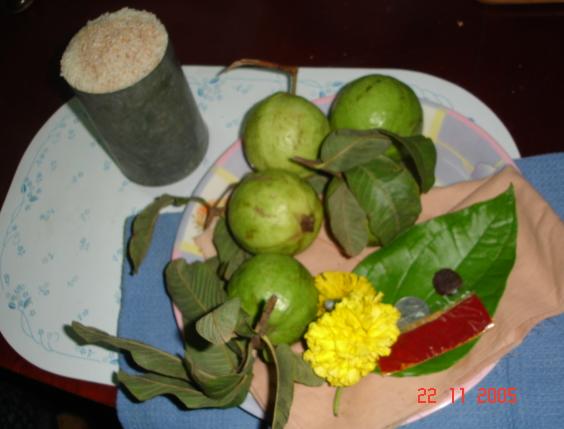
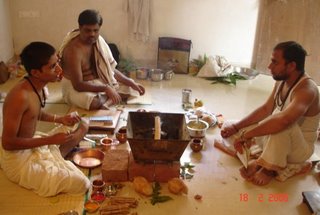
The next picture I want to show you is what the neighbor's daughter brought me one day. It's part of a monthly prayer (pooja) she's doing. She visits a married woman each month for a year starting with her own mother. Each time -as part of the prayer - she takes fruits, rice (an amount which is determined by weight), flowers, a betel leaf, a piece of cloth (which would be used to make a sari blouse), among other things. The purpose is that each time she visits a married woman, she can learn something about married life and the year long offering will help her find a good husband.Here's a picture of three priests performing a Vastu Shanti, which is a housewarming ceremony that is celebrated before a couple moves into their new home.
The following three pictures are dedicated to people who play an important role in our life here.

The couple you see in the next picture are in charge of collecting the trash from each home in our sector EVERY day.


Here's another VERY important person, our dhobi

. Normally, 'dhobi' designates the person who does the laundry, but in this case he's in charge of coming to your house and taking the clothes you want him to iron. The next day he returns them neatly pressed. He takes loads of clothes back and forth in his bicycle. Heavy irons are used to press the clothes and they are heated with coal. It's probably the worst job to have in the summer! Ishan thinks that setting up a 'dhobi' service in Costa Rica would be a good business. I'm sure many people would be willing to pay for someone to relieve them of the agony of hours standing by the ironing board.


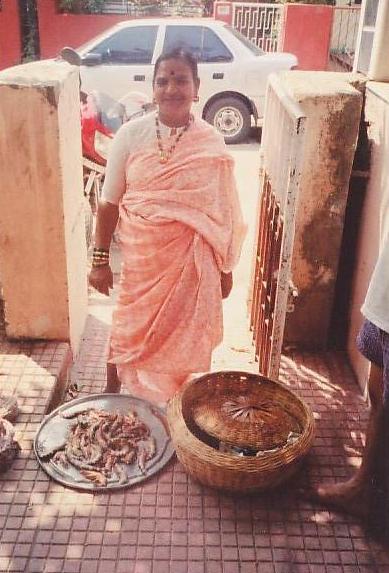
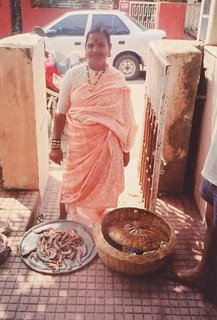
Here's a very proud looking fisherwoman offering her fresh goods. Ishan's parents really like fish, so she knows she's got customers when they come to visit.

Yes! It's true! You do see elephants on the streets and highways in India. Of course, they're not intended for public transportation (at least in Mumbai!) When my parents came to India they saw their first elephant on the highway on their way from the airport. The picture below was taken in Vashi. Once I read an article about how elephants were disrupting traffinc in Delhi, so they now have a specific time in the evening when they can walk the streets, and since it gets dark, they have to wear light reflectors so that the cars and trucks don't miss them.
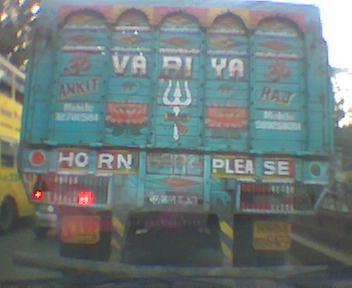
Here trucks are almost always seen in the MIDDLE of the road instead of driving in the center of their correspondent lane. It's common to see signs at the back of the trucks 'HORN OK PLEASE', indicating that if you want them to move into their lane, the driver DOESN'T mind if you honk at them! It's the complete opposite in Costa Rica, where honking is considered very rude, but people still do it. (Unlike in Germany, where it's also very rude and people hardly ever honk - probably only in an emergency.)
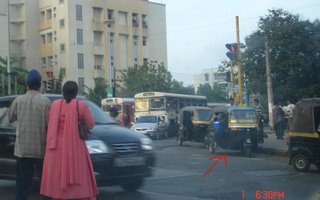
Speaking of the Costa Rican honking practices...when you're the first one waiting for the traffic light to change (also known, as the 'signal' here in India), the car(s) behind you will surely honk in a plank! I was thrilled to see that the traffic lights here have a counter. Look at the picture below where I have circled the counter. Isn't it great? You know exactly how many seconds are remaining before the light changes!

In this picture you can also notice a couple of BEST (Bombay Electric Supply and Transport) buses crossing the road and also a woman dressed in a sari in the left-hand side of the picture.


This is the last picture related to traffic. I've pointed out an auto-rickshaw, a very practical and popular means of public transportation for short distances. Notice the woman on the left-hand side of the picture: she's wearing another traditional Indian outfit, the salwar-kameez.


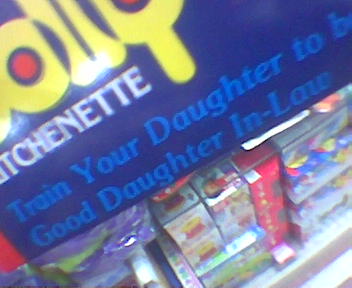
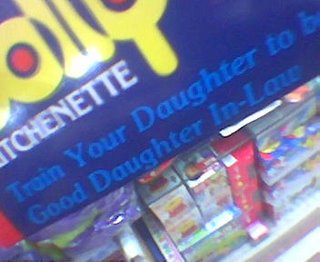
I have reserved my favorite picture to end this 'India Week'. It was another culture-shocker for me. I'm glad my cellphone had a camera because I was able to take this picture in a store and now I'm sharing it with you. The picture is a detail of a toy kitchen set. Here's what caught my attention: The box says "Train your Daughter to be a good Daughter-In-Law".

I will give a moment to all of you who are reading this and think you need to recover from the same 'shock' I got.

You see...I'm sure my Mom wanted me to learn how to cook because it's important for everyone to be independent and preparing food is definitely in the list of needed survival skills. My Mom also told me that the best way to get to a man's heart was through his stomach, but I was hoping to find someone like Jamie Oliver. In case I ever ended up with a tiny baby who depended on me for his food I already had planned on being the number 1 customer for Gerber until the baby would learn how to cook for himself...and later on, hopefully cook for me too!

So, according to my upbringing I would understand if the box with the kitchen toy set would have read:

"Train your Daughter to be a good Cook"

"Train your Daughter to be a good Wife"

"Train your Daughter to be a good Mother"

or even better:

"Train your Kid to be a good Cook" (I'm hoping to teach Fabi to cook...and not just because I want him to cook for me!)

So, unless you have seen how the family dynamics work here in India, a comment like the one on the box just boggles the mind (to say the least!) When I was getting the first taste of how my life had changed with Fabi, I mentioned that in some societies in Africa, I wouldn’t even be considered a woman because I didn’t know how to cook. I guess in these places in Africa, the box would read: "Train your Daughter to be a person"....so I guess the Indian version is not so bad after all!

So...there you have it!...My very own version of photodocumentary on my life in India (so far). Thanks for reading this far and for your patience. I noticed that many pictures on my blog makes it so slow that it takes forever to open (especially if you click on one of the links that I have added in some of the pictures' description.)
I already have some ideas for another version of 'India Week'...after all...it's through my descriptions that many people outside India would hear about 'vegetarian toothpaste' for the first time in their lives! ;)

Labels:

Saturday, March 18, 2006

'India Week' - Way of Life - Part I

The remaining pictures I will share with you belong to several subcategories. I'm sure that all those of you who are not Indians and have asked me how have I adapted to live here, will find this very interesting.
The famous CST railway station in Mumbai is now a World Heritage Site. Travelling by train in the city of Mumbai can be quite challenging because of the dense population and I am proud to say that I've managed to do that on my own a couple of times. I took the following picture of a toilet sign at that train station because I thought it was very interesting to see the lady dressed in a sari. Notice that the sign reads 'STOP AIDS' at the bottom.
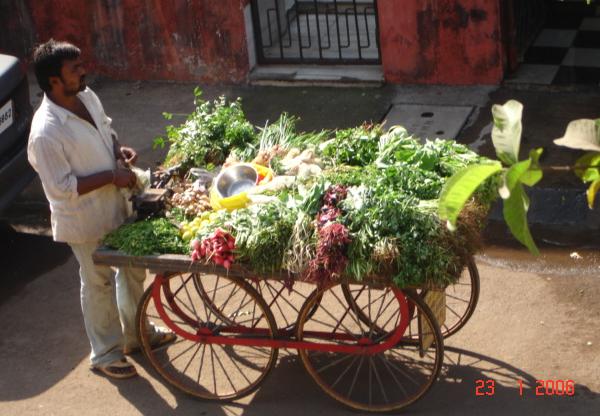
Ever since I came to India, I've been living in the largest planned new city in the world. Vashi is a very nice place to live (it's far away from the hectic city life of Mumbai downtown). Unlike other places-for example, Germany-where you have to plan in advanced your weekly shopping, here you can rely on vendors that come EVERYDAY to your doorstep. There's a man who comes with a cart full of fruits, another one who comes with a cart full of vegetables...

... another vendor offers all kinds of (green) leaves...

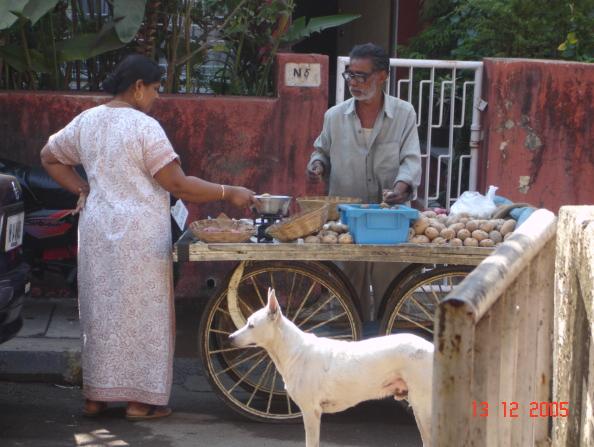
and another vendor specializes in onions and potatoes. Each of these vendors have their own distinct way of calling out their goods, for example you hear them shouting "Here comes the one with vegetables!!!"

Also notice the dog in the picture below. It's one of the several street dogs that live in this lane (i.e. block). Those dogs are so popular in the neighborhood that they even have names and they bark incensantly at other dogs who don't belong to this area. I think the one in the picture is 'Sparky'.

The following three pictures are all related to the construction industry :) What safety laws do you expect in a place where it's legal for babies and little kids to ride in the passenger front seat of a car, or for entire families to ride in a motorcycle? Well....homemade scaffolds made out of bamboo...

...or acrobatic workers who can come down by jumping out the window (without shoes!)

The person carring bricks on the head is a woman. She has a small baby - a little younger than Fabi - who hangs out near this construction site. I didn't like the feeling I got the first time I saw women doing this type of job. :(

On a drastic change of topic, I'll show you a picture I took with my cellphone camera. It shows my arm with the most number of bangles I have ever worn at one time. The dark green bangle (first one from left to right) and the golden bangle (last one from left to right) are traditional and have a specific meaning. The other ones are just to decorate and they match the outfit I wore for the 'function' of my 'Indian baby shower'. The sequence in which I wore the middle bangles was designed by Ishan's Dad. He actually came up with several options and I discovered it takes imagination to come up with a good design.

This is a picture of a baby crib. When I put it together to see what it looked like, it reminded me of the toy one I had when I was a little girl. I was surprised to see how low the crib is. It was mostly used in Fabi's Naming Ceremony.

Sopan and Priya showed up one day with a surprise for 'Golu' (as they call Fabi). It turned out to be a toy mask with a face of Hanuman. "Who is Hanuman?", you ask...and so will Fabi...so now I have one more reason to go and learn about Indian Mythology!

I wrote about this before: I mentioned that fair (white) skin is considered an asset in India. Here's a picture of the products for women and men who want to believe that white is better.

(Click to enlarge image.)

Tomorrow I will post the last set of pictures for this 'India Week'.

Labels:

Friday, March 17, 2006

'India Week' - Indianized Goods

Today's post is about things that I've found here in India that have been adapted to its culture. It's one of my favorite topics!

I used to think that when I had a baby I was going to be the number 1 customer of Gerber baby food. I had Gerber as a baby and I remember my younger brothers also having it. When a jar of Gerber is opened it makes a distinct popping sound, which used to let me know that a snack was on the way!... I even liked to have Gerber baby food for snack as a grown up: apple sauce, banana dessert, prunes, peaches, etc. I also remember tasting a vegetable jar once and discovering that it tasted awful!

Because the kitchen has never been my favorite place, I thought I would rely on ready-made baby food once Fabi would start having solids. But to my surprise...it's not widely available here. Anyway, I have to admit that cooking daily fresh food is a lot healthier for him, but I did want to have a couple of jars of Gerber for the long car ride when we went to visit his grandparents in Dhule for Diwali. I had to visit two different shops where they sell imported goods. None of them had what I was looking for, but I was able to place an order through one of those shops. The next day I had four jars of baby food. I don't remember the price, but I'm sure they were a lot more expensive compared to the cost of homemade food. It also turned out to be very impractical because Fabi ate more than one jar in a sitting. At least I got to taste some of it too :) Here's a picture of the empty jar. Notice the writing in arabic on the label.


Mc Donald's! I like it because as a kid going to McD's was a real treat! I grew up enjoying my visits to this fast food restaurant...and was very happy when the breakfast menu was introduced in Costa Rica. During my backpacking days in Europe, when I didn't have the time or money to find a good place to eat local food, McDonald's always made me feel 'at home'. I admit the food may not be the tastiest or the healthiest, but I still enjoy the ocassional visit. I think that a glass of Coke tastes MUCH better if it's from McDonald's!

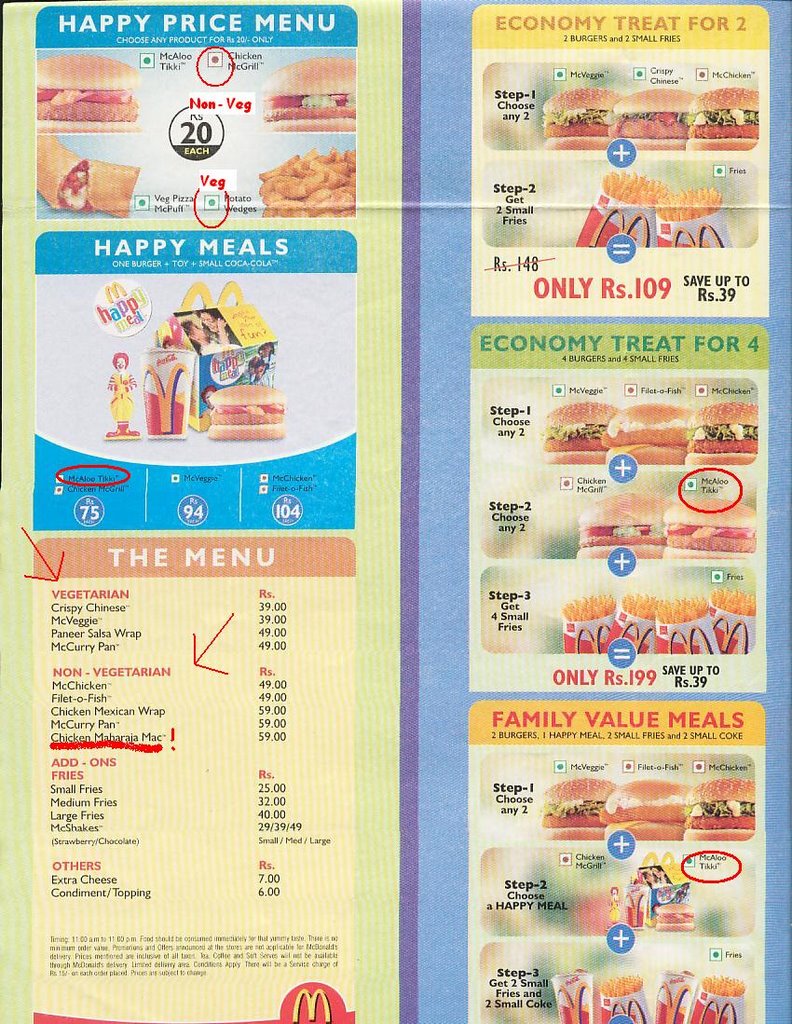
Of all the things I had heard about India before coming here for the first time, the one that stood out the most was: "They have a vegetarian menu in McDonald's!", so naturally I was really interested in going to eat there to see if this was true. Actually, they have both vegetarian and non-vegetarian menus, but they don't serve beef. In other words: it's been more than two years since I haven't had a Big Mac.

Here's a placemat that I brought home with me. It shows a an indianized Ronald McDonald.


I scanned a menu to show it to you. Notice that the vegetarian dishes have a green 'dot in a square' symbol to identify them and the non-veg have a brown one. The prices are in Rupees (Rs.) . [1 US Dollar = 44.28 Indian Rs. according to this conversion.] I have made red marks in the menu to point out the interesting variations of the local menu.

(Click to enlarge the image.)


I like to have cereal for breakfast in the morning. I’ve noticed that there’s not a huge variety of cereal brands here but at least I have enough to choose from. Kellogg’s is a familiar brand, however I had never seen a “Mango Flavor” before. Mangoes are very common in Costa Rica…in fact, sometimes it has been referenced as the ‘Mango Country’. What I discovered later was that mangoes are originally from India and that the best type of mango is a variety called ‘Alphonso’. It’s SO good that during mango season, many ‘alphonsos’ are exported, mainly to Europe.


Speaking of cereal, Cerelac by Nestle is supposed to be baby food, but since Fabi doesn’t like it, I have it for breakfast. Notice that the box in the picture says: “Dal Palak”, which means lentils and spinach.


I’ve mentioned before that Fabi mainly wears cloth diapers. Of course, I have the advantage to have someone to help me wash them, but they are an advantage because it’s healthier for his skin, it’s more environmentally friendly, it’s cheaper, and it’s supposed to help him get toilet-trained faster. However, I rely on disposable diapers so that he can wear at night or whenever we go out of the house. I tried some Indian made disposable diapers, but those gave Fabi a rash. So I rely on the imported kind, mainly Pampers or Huggies. I took a picture of a package of diapers to show you the japanese (?) written on the it, because they are imported from Japan. Another interesting aspect is the size of the package – I wanted to compare it with something small and I only had a AA battery at hand. I find that here in India it’s very easy to get small things. USA and now even Costa Rica are submerged in consumerism and everything has to be BIG. In fact, when I was studying in Germany I used to find it difficult to go shopping at the supermarket because things also came in big packets. I didn’t like to use my refrigerator space in my hostel so it was hard to shop just for one person. Here in India it would be very easy to do that: I’ve seen tiny bottles of coke sold in street corners, or very small packets of soap (like hair shampoo or even Tide). It’s the complete opposite approach of warehouse clubs like Price Smart!


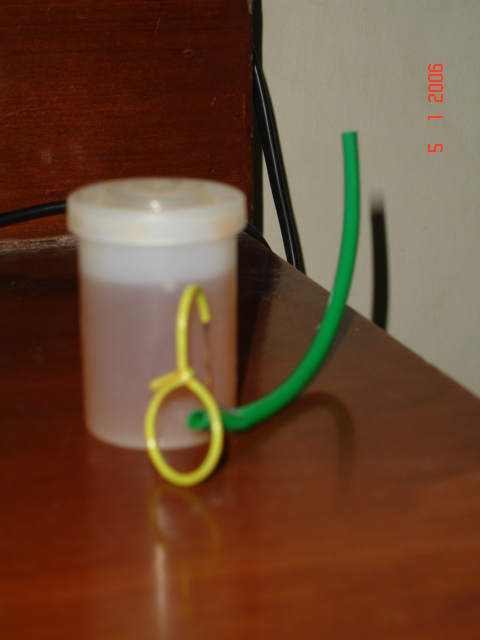
Here’s a favorite toy of mine: a bubble blower! Notice that the (somewhat blurry) picture below shows a 35mm film case to store the soap. The bubble wand is made of wire cable! I bought this for 5 Rs. during Diwali season. Fabi loves it when we go out on the terrace and make bubbles!


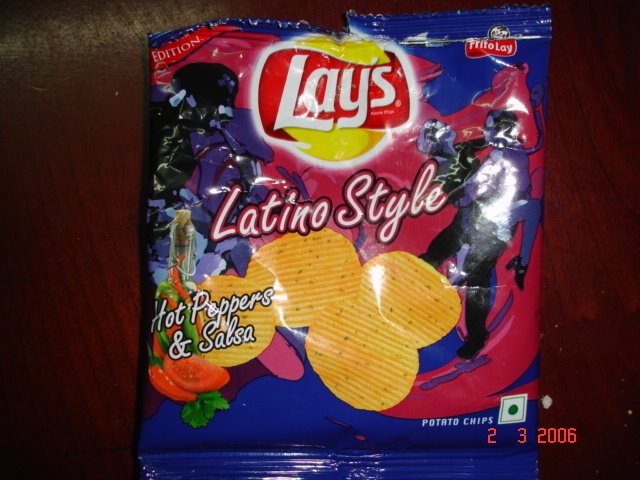
Indians have their own yummy snacks and potato chip brands like Lays are now also marketed under different flavors. For a snack to be well accepted it should be spicy and the latest Lays flavor is called Latino Style. I would understand it if such spicy flavor would be called Mexican Style…now Indians are going to think Latinos like to eat chips this hot! I think this small package of chips cost 5 Rs. and the chips were practically gone before I could finish opening it (it felt like it had only 6 chips in it!)


The last pictures in this category show bottles of the well-known beverages Coke and Pepsi. Both brands rely on famous movie stars to advertise them. The Coke bottle shows a label advertising the Mumbai Festival which took place at the beginning of the year.


Sometimes there are limited-time offers like ‘Vanilla Coke’ or like the one in the picture which suggests a cappuccino flavored Pepsi. The funny thing about this picture is that it shows the label: ‘Café Chino’, which in Spanish would mean ‘Chinese Coffee’.

(Click to enlarge the image.)

Labels:

Thursday, March 16, 2006

'India Week' - Popular Tools

Today's theme is about popular tools I've seen here in India.

First of all, I will mention the newspaper. Lots of things you buy in the street are wrapped in newspaper: snacks, vegetables, souvenirs... Newspaper is used to absorb the grease of an oily snack or to keep humidity away from fruits and vegetables. This was one of the early culture shockers for me: noticing a street vendor handing out snacks wrapped in newspaper, including an extra piece for a napkin (i.e. 'tissue paper') or finding something in the refrigerator wrapped in last week's news! I have to admit that the use of newspaper is very environmentally friendly, but in Costa Rica we don't use it to wrap anything edible. Instead, we use aluminium foil, wax (oven) paper or kitchen paper towels. These products are also being promoted here in India through some adds I've seen lately.

This picture shows a bag made out of newspaper. It was used to wrap some souvenirs that MasalaDad brought me from one of his recent business trips.


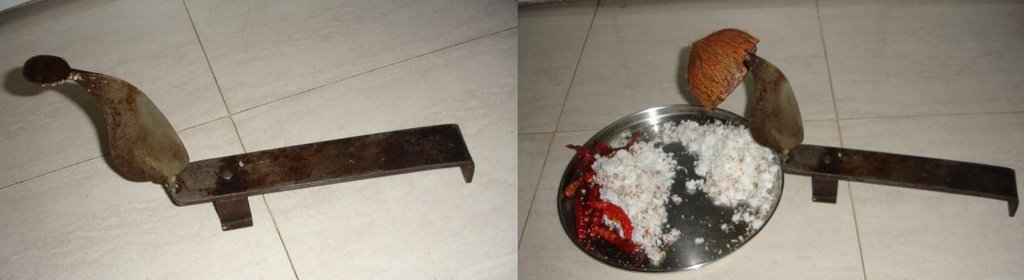
The next picture is a coconut scraper. Coconut is an important ingredient in several Indian dishes. Coconuts are widely sold and used in various ways: to drink its water, to scrape its flesh and use it as an ingredient in recipes and even to offer them to a deity in a temple or in the shrines that people keep in their houses. Coconut oil is also very popular for head massages: it's suppossed to help cool off and help make the hair shiny and healthy. The left-hand side of the following picture shows one type of coconut scraper. The right-hand side shows the scraper with a tray of coconut flesh and red chillies. These ingredients were later added to a dish of fish curry. When Ishan's mother saw me taking a picture of this, she was curious and asked me how do we scrape the coconut in Costa Rica. I told her coconut is mainly used in some desserts and we just get packages of it at the supermarket.

(Click image to enlarge.)

Behold the 'Indian broom'! They come in different sizes; some are made of harsh straw to sweep exteriors and some are softer to sweep indoors. If you're not used to these types of brooms it can be very harsh on your back: you have to bend or squat. However, if you're used to them, you will do a better sweeping job than with a 'western' broom. I've also seen versions of the 'Indian broom' that have a long stick attached to it and they’re used to sweep the streets or construction sites. Nowadays, you can also find the same design made out of plastic and therefore, in different colors!


If you're not from India, I challenge you to guess what the object in the next picture is! To me it looks like a weapon, but it's actually a board to hit the clothes as they're being washed. That's right! The clothes are soaked in soapy water and then 'punished' to get the dirt out. I wonder who came up with this system?!...

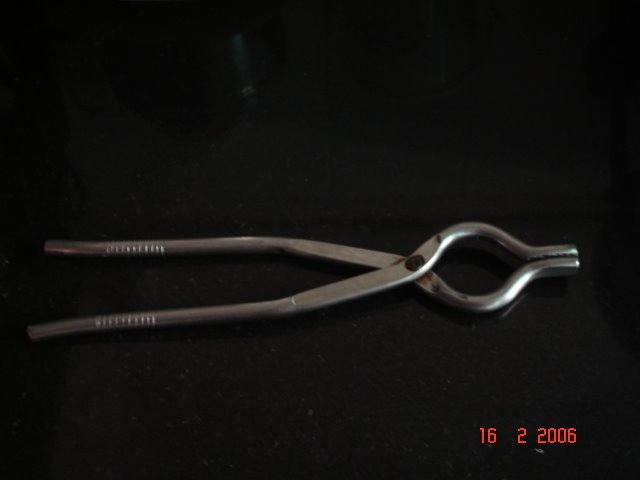
Here's another interesting object that looks like it belongs in a mechanical shop or in a dentist's office, but it actually belongs in the kitchen. Read on...

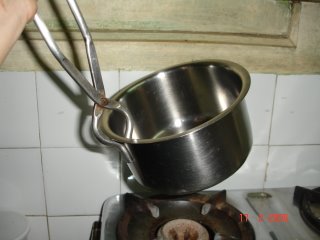
This is a common cooking vessel (i.e. pot), made of steel just like many other cooking utensils. Some vessels also are made of aluminium or copper, but have the same style as the one shown in the picture.

Since these utensils get hot while cooking, the 'plyers' shown before are used to hold the hot vessels, just as shown in the picture. I’ve seen two different types of plyers. They’re not difficult to use.

Here's a view of a common dishholder found in many Indian homes. Shiny, isn't it? I told you steel was popular!

Chapatis are the ‘daily bread’ around here. Fresh homemade chapatis are quite popular eventhough you can also get them readymade and heat them in the microwave. The dough is made out of wheat flour, oil and salt. A little ball of dough is then extended on a round board with the roller stick (seen in the picture below) and then placed on the stove until the chapati is ready. Other chapati-makers are also available, which guarantee the outcome of a round chapati from the dough. The Costa Rican version of chapatis would be the ‘tortillas’, which are also flat and round but made out of corn flour. Traditionally, fresh ones would be made every day and women used nothing except the palms of their hands to make perfectly round tortillas. Now they’re mainly bought readymade.

Just thought I’d post a picture of Fabi getting familiar with the board and roller stick to make chapatis. Notice he’s sitting on the kitchen floor next to his grandmother right before cooking a batch of chapatis. Also notice the newspaper sheet under the board – to protect the floor.


This next picture shows two ‘dabbas’ (hindi word for lunch) or ‘tiffins’ (old fashioned English word for lunch box). They come in different sizes and have separate compartments to store the food, usually, rice, dal, a vegetable item, a salad and of course, chapatis. Many people who work in Mumbai city order their homemade-style lunch that they get in dabbas. This is so common, that there are people known as ‘dabbawallas’ (meaning, the one who carries dabbas) who are in charge of delivering these lunches to office buildings.

When I used to work here in India, MasalaDad and I ordered our dinner in a dabba. People don’t need a lot of furniture here in India and are comfortable eating while sitting down on the floor. I took this picture with my camera phone. It shows the sitting arrangement. Notice the newspaper sheet on the floor and the steel plate, cup and spoon on Ishan’s side. Those were my earlier days here, now we have a table and real placemats (that match my Corelle set!)

This last tool is not necessarily ‘Indian’, but it’s very useful here in (Navi) Mumbai, where the swampy area is the perfect place for all those mosquitoes to grow. When you wave this racket and press the button on the handle, an electric shock kills the mosquitoes that come in contact with it. Now that summer is here, the number of mosquitoes has come down significantly. I’m very glad because even though Fabi slept under a mosquito net, he sometimes got bitten during the day.

Labels: